
Digital transformation is no longer a discussion limited to technology companies. In logistics, it has become an important condition for maintaining competitiveness, productivity, adaptability, and the pursuit of better business results.
Even so, many companies still treat digitalization as synonymous with implementing systems, automating processes, or acquiring new tools. These elements are important, but they represent only one part of the transformation.
“For a CEO, the main question should not be, ‘What technology do we need to implement?’ but rather: ‘What kind of company do we want to build, and what changes do we need to make to get there?’”
Over the past few years, it has become increasingly clear that digital transformation does not happen through technology alone. It requires changes in how an organization makes decisions, structures processes, uses data, develops people, and connects different areas of the business.
Start with the problem, not the technology
One of the most common mistakes in digital transformation projects is starting with the solution. Companies implement sophisticated systems before clearly understanding the problem they need to solve. The result may be a more technology-enabled operation, but not necessarily a more effective one.
In logistics, for example, different challenges require completely different responses: limited operational visibility, excessive manual activities, difficulty forecasting demand, poor integration between departments, high transportation costs, inefficient route planning, inadequate pricing, low productivity, or limited ability to monitor performance indicators in real time.
Before choosing a technology, leadership must understand where the operation’s main bottlenecks are, which factors are negatively affecting revenue, and what impact they have on the business.
Consistent transformations usually begin with simple questions: Where are we losing efficiency? Where is rework happening? Which decisions still depend on fragmented information? Which processes can no longer keep pace with the company’s growth? Where are we destroying value?
Technology should come later, as a tool for addressing these challenges.
Data must become decisions
Logistics companies generate large volumes of information every day. Orders, inventory, routes, deliveries, productivity, costs, service levels, pricing tables, and customer behavior continuously generate data.
The problem is that having data does not necessarily mean using it effectively.
In many organizations, information is spread across different systems, business intelligence platforms, spreadsheets, and departments that do not communicate effectively with one another. When this happens, leadership may end up making decisions based on only a partial view of the operation.
A mature digital transformation must create a structure in which data is reliable, accessible, and useful for decision-making. Data must be transformed into meaningful information.
For the CEO, this means fostering a culture in which data is no longer used merely as a monitoring tool but instead begins to guide strategic decisions.
The question is no longer simply, “What happened?” It expands to include: “Why did it happen?”, “What is likely to happen next?”, and “What decision should we make based on this information?”
It is at this stage that technologies such as artificial intelligence, predictive analytics, and automation begin to generate real value.
Digitalization is also a cultural transformation
Perhaps the greatest challenge of digital transformation in traditional companies lies not in technology, but in people.
Organizations with decades of history have usually built processes, structures, and management models that contributed to their success. For that very reason, change can be particularly difficult.
When new technology is implemented without clearly explaining its purpose, resistance and uncertainty are natural reactions.
Leadership’s role is to demonstrate that digital transformation does not simply mean replacing people with systems. The goal should be to create conditions that enable teams to work more effectively by reducing repetitive tasks and increasing their ability to analyze, make decisions, and generate value. Leadership must foster engagement.
In this process, communication and training are just as important as technological investment.
People need to understand why the change is happening, how it will affect their work, and which new skills will be required.
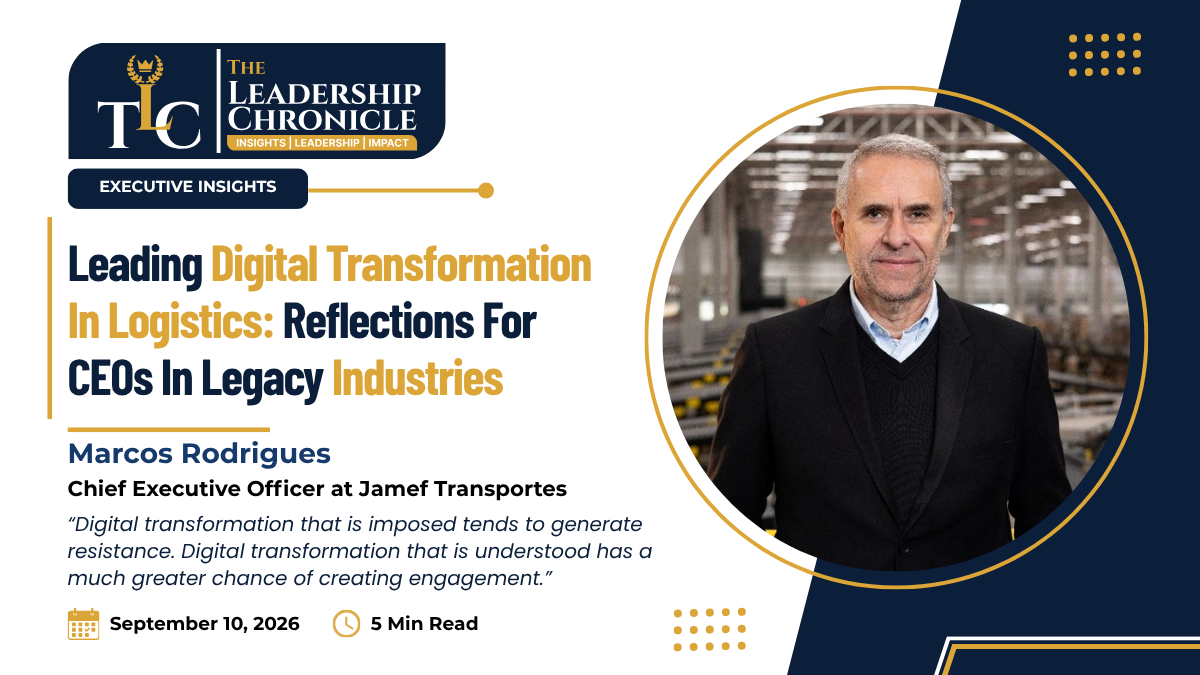
“Digital transformation that is imposed tends to generate resistance. Digital transformation that is understood has a much greater chance of creating engagement.”
Digital transformation must be tied to business results
For a CEO, every transformation process must be connected to the company’s strategic objectives.
Reducing costs, increasing productivity, improving service levels, reducing errors, increasing predictability, improving pricing, and accelerating decision-making are examples of outcomes that can guide investments.
Without clear metrics, digital projects risk becoming permanent initiatives without the organization ever being able to identify the returns they generate.
That is why it is important to establish indicators from the outset and continuously monitor whether the transformation is delivering the expected results.
In traditional companies, it is often more effective to identify a relevant problem, implement a solution on a controlled scale, measure the results, and gradually expand what works.
This approach reduces risk and helps the organization build confidence in the transformation process.
The CEO must lead the agenda
Digital transformation cannot be the sole responsibility of the technology department. When it is treated simply as an IT project, it rarely changes the company at a structural level.
The CEO must take on the role of transformation sponsor by setting priorities, removing barriers between departments, and ensuring that technology, strategy, and operations move in the same direction.
Traditional companies have an important advantage: accumulated knowledge, operational experience, and a deep understanding of their markets. Digital transformation does not require abandoning this legacy. On the contrary, leadership’s challenge is to combine what the organization has built over the years with new technologies, new capabilities, and new ways of working.
“Ultimately, digital transformation does not mean turning a traditional company into a technology company.”
It means building an organization capable of using technology to make better decisions, operate more efficiently, and remain relevant in a market that is changing at an increasingly rapid pace.