
Innovation in artificial intelligence is happening faster than ever, and it only continues to pick up speed. Entire businesses and vendors are at risk of becoming obsolete because the value they used to create can be delivered by the latest release from frontier AI labs. Undisciplined spend on AI has not yet become a bright enough red flag, despite many stories in the news about token burn, so the best defense against obsolescence is creating an evergreen value-delivery engine. This isn’t a new problem: innovation has always put organizations at risk. But the speed at which innovation is happening and the cost to access that innovation have so vastly changed that there is no surviving this wave without evolving.
Thriving, not just surviving, in this brave new world necessitates that organizations find a different way of thinking and building. This approach used to be referred to as “using Platforms” — it’s how organizations can leverage components and systems from external parties to build on and deliver net value. In the past, platforms provided focused capabilities: Twilio provided APIs for messaging as the “Communications Platform” and AWS provided cloud-hosted compute and other services as “a Cloud Hosting Platform”. AI models are now “a Platform” in many ways as well, and organizations need to treat them as such.
Organizations that fail to do this will quickly see their value-add and thus chance at revenue capture trend toward zero. And this will not be a linear degradation; it’ll be an asymptotic one.
"The word to notice in this paragraph is “asymptotic.” Lost value rarely arrives as one dramatic event; it arrives as a steady narrowing of the gap between what an organization charges and what a model can deliver for free. Leaders who wait for an obvious alarm tend to notice only when most of the damage is done."
The Art of Jiu-Jitsu, as applied to AI
The Art of AI Jiu-Jitsu refers to the ability of organizations to create a new mental and working model to continually benefit from the innovation happening around them. To thrive, organizations must find ways to harness that momentum instead of competing with it. “Not invented here” mentalities must be flushed out because no company can continue to create value and compete with the totality of innovation happening outside. Instead, they should:
focus on what they can do well
identify their unique value-add
continue to build and deliver that value on top of the new technologies released on a near-weekly basis
Put in a more structured manner, organizations need to think about the value they deliver as an [x + y] value proposition where:
[x] is the value offered by a new AI technology (“Platform”);
[y] is the maximized value the organization can uniquely create and deliver.
Explicitly incorporating and leveraging AI in that value delivery (“[x]”) means organizations will always be more valuable and thus harder to replace by a single AI innovation.
This looks a bit different for Independent Software Vendors (ISVs) than it does for standalone businesses. For ISVs, this change also means starting to think more like systems integrators. Development and delivery frameworks that allow for “plug-and-play” of new AI technologies and tools are critical in determining how well ISVs can continue to be relevant to their customers. The same [x + y] style value-math applies. However, whereas ISVs used to be able to claim value for all of the components they brought to the table (including the “[x]”), AI innovation and capabilities are public-domain knowledge, so ISVs are forced to compete purely on their ability to provide a differentiated [y] value. For ISVs to be truly successful, the value story needs to feel closer to [x*y] than [x + y].
"Treat [x + y] as a practical test. List what in your offering is [x], available to any competitor using the same model, and what is genuinely [y]. If the second list is short, the strategic question is no longer whether to adopt AI. It is what you can build that AI cannot hand to a rival."
So, what do you do?
Ironically, the skills and frameworks required to perform this AI Jiu-Jitsu lean on many principles that already exist and were once coveted across the technology and business worlds. The SWOT (strengths, weaknesses, opportunities, threats) analysis framework is one such tool. For years, this was taught in business classrooms and online courses as a key tool for organizations to assess their potential strategies and plays. It is the same battle-tested framework, except there is now a special emphasis on two of the dimensions:
Strengths: what you do uniquely well, which others can’t easily replicate.
Threats: AI being able to “do” the things that are in your Strengths, or enabling competitors to do these things as well.
Organizations must find durable Strengths — those that are hardest for AI to replace. The ability to execute repetitive tasks at scale is no longer a Strength — in fact, it was the first differentiator to be cannibalized by AI in many forums. Tasks that require domain expertise are often more durable.
Organizations must also be realistic about the Threats that exist — AI is now a Threat. But it doesn’t have to be. Without change, AI will be both a direct threat when new releases automate things that were previously organizational value or Strength, and also a threat when it is an enabling technology for competitors to replicate those Strengths or value. AI Jiu-Jitsu is about recognizing this Threat and finding ways to incorporate AI so it amplifies your Strengths rather than fighting it head-on.
Lingering is tantamount to Losing
If there is one lesson everyone must take away from this in-progress AI-driven transformation, it is that no one can feel confident in standing still, even if you are differentiated in some way. Everyone must continue to innovate and evolve to survive. Past business “moats” such as large corpora of data or high migration costs that act as barriers to exit have been negated by the speed and scale of what AI can do. Businesses are no longer building mountains to stand on; they are building piles of sand at the beach. Every innovation in AI will chip away at or entirely wash away those differentiators.
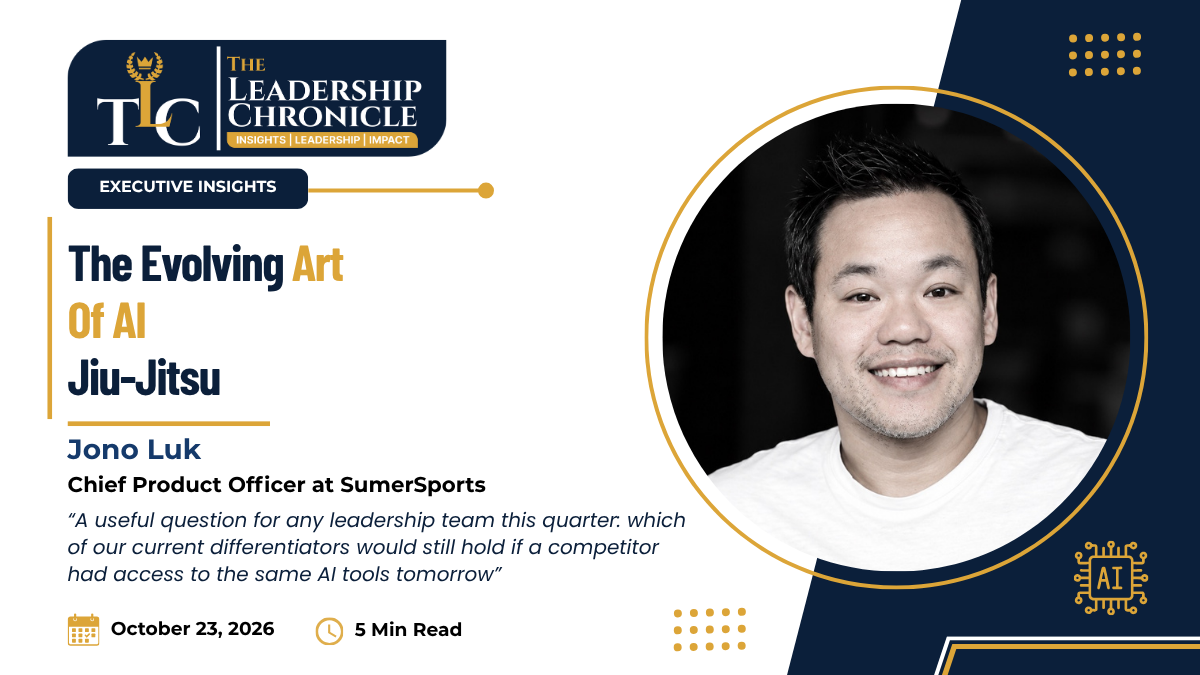
"The article makes a pointed case that standing still is itself a decision. A useful question for any leadership team this quarter: which of our current differentiators would still hold if a competitor had access to the same AI tools tomorrow?"
Start today to have a tomorrow.
“Harnessing the power.” “Leveraging the momentum.” “Building on top of.” The trends and patterns are clear: it is of the utmost importance and urgency for organizations to structure themselves to capitalize on the innovation happening outside their four walls. Organizations will never be able to put enough capital into trying to outcompete the frontier labs. So why waste energy and, more importantly, time and dollars? Find a way to fit that innovation into your organization and accelerate from it. Those that haven’t already are at existential risk. Those that won’t will quickly find themselves searching for entirely new lines of work.