How open tables could become the shared data foundation for intelligent systems
The next major shift in enterprise AI may happen below the model layer. Models are becoming more capable and interchangeable, but an AI system is only as dependable as the data it can discover, govern, and reproduce. Apache Iceberg is emerging as a consequential part of the answer. It is an open table format that defines how large analytic datasets are organized and tracked across files, snapshots, schemas, and partitions. If it becomes a common contract across the AI data stack, its impact could extend far beyond faster analytics.
From files to dependable tables
Object storage made it economical to retain enormous datasets, but files alone do not provide database behavior. At scale, teams must coordinate concurrent writes, evolve schemas, update rows, discover relevant files, and reproduce the exact data used by an earlier computation. Historically, each engine or platform often solved these problems through its own metadata and conventions, creating copies, brittle pipelines, and operational lock-in.
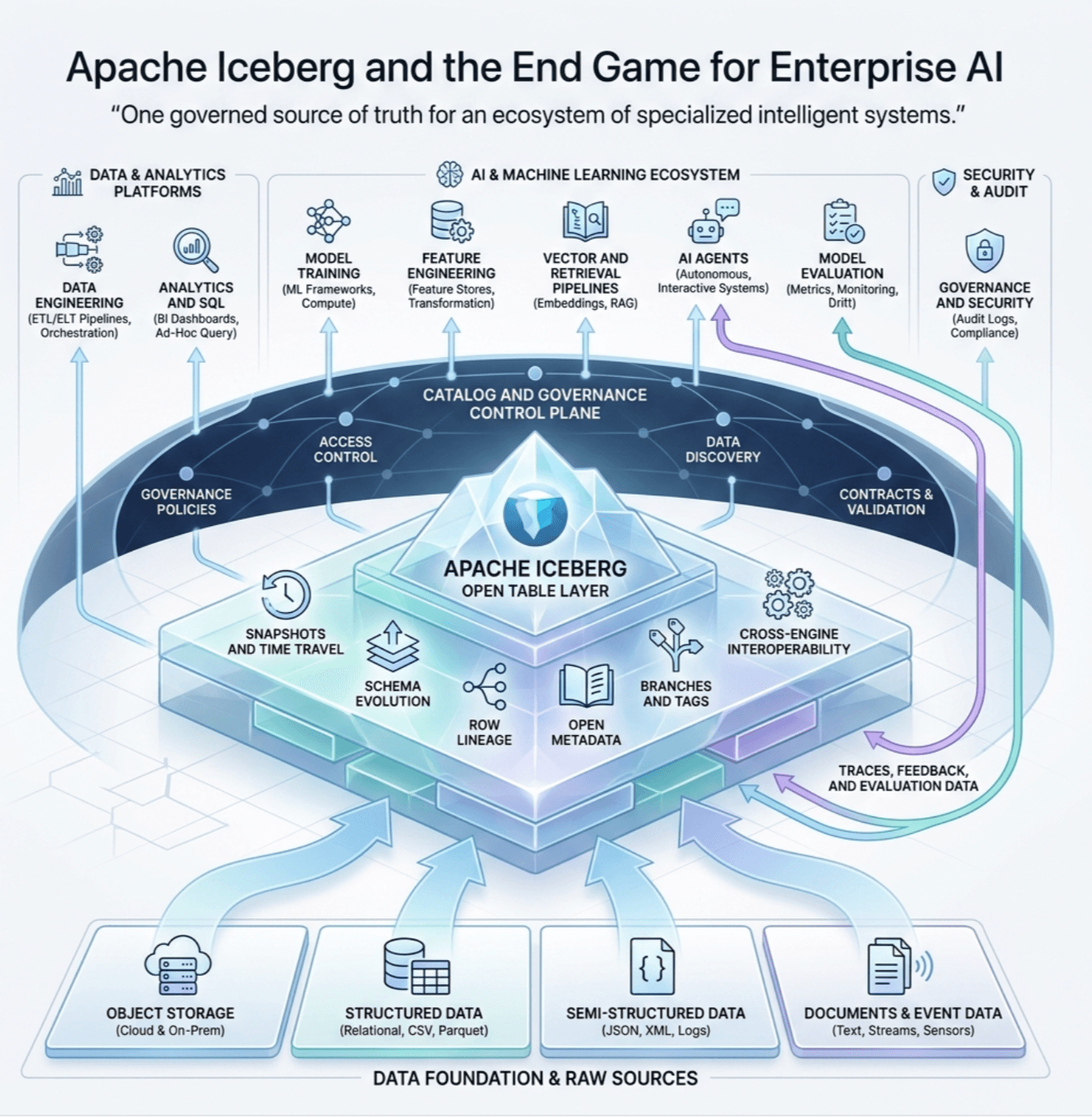
Iceberg brings table-level structure to data stored in open file formats. Its metadata model records snapshots and manifests rather than relying on directory listings. Features such as atomic commits, schema evolution, hidden partitioning, row-level changes, and time travel give engines a consistent interpretation of a table. Spark, Flink, Trino, and other systems can work with that table without reducing it to an ungoverned collection of files.
This is the architectural shift: the durable asset becomes the table and its history, while compute becomes more interchangeable. Organizations can choose different engines for streaming ingestion, transformation, interactive analytics, or machine learning while preserving a common data foundation.
"This reframing — compute as interchangeable, the table as the durable asset — is the single most useful idea in this piece for any leader deciding where to place long-term infrastructure bets."
Why this matters for AI
Modern AI turns data infrastructure into a continuous system. Training data is filtered and transformed repeatedly. Evaluation sets change. Retrieval pipelines build embeddings and other representations. Agents generate traces, tool results, feedback, and safety signals that flow into future iterations. A model is therefore not produced by one static dataset, but by a lineage of data states and decisions.
Iceberg's snapshot model can make those states explicit. Time travel allows a team to query a prior snapshot, which supports reproducible experiments and post-incident analysis. Schema evolution lets datasets change without forcing large rewrites or confusing a renamed field with a new one. Branches and tags can support isolated data changes and retained reference points. These features do not create ML governance by themselves, but they provide strong primitives on which governance systems can be built.
"Most AI governance conversations focus on model behavior. This is one of the clearest arguments we have published for why governance actually starts one layer down, at the data itself."
The format is also evolving toward data that AI applications increasingly consume. Iceberg version 3 added support for variant data, row lineage, deletion vectors, default column values, and additional data types. Variant is particularly relevant for semi-structured events and agent traces whose fields differ across records. Row lineage introduces stable row-level identity for newly created rows, while deletion vectors make certain row-level changes more efficient to process. Together, these capabilities narrow the gap between flexible AI data and dependable table semantics.
This could materially change the economics of AI. Organizations frequently copy data into warehouses, feature platforms, vector systems, and training environments. Each copy adds cost, delay, and another opportunity for definitions to drift. Iceberg will not remove every specialized representation, but it can make those representations reproducible derivatives of a governed source. Training, evaluation, retrieval, and analytics can begin from a shared snapshot and retain a traceable relationship to it.
The ecosystem effect
The broader impact of Iceberg will be determined less by any single feature than by interoperability. An open specification gives storage systems, catalogs, query engines, governance products, and ML frameworks a common contract. When that contract is implemented consistently, innovation can happen independently at each layer.
For researchers, this creates a clearer path from prototype to production. A new optimizer, multimodal pipeline, or policy engine can operate against a standard table abstraction instead of requiring a proprietary ingestion path. For enterprises, it can reduce unnecessary movement and duplication. For platform builders, competition shifts toward execution quality, governance, and user experience rather than control of a closed storage representation.
This does not eliminate hard distributed-systems problems. A format cannot guarantee that every engine supports every feature correctly or at the same time. Catalog availability, authorization, commit coordination, metadata maintenance, compaction, and performance tuning remain operational responsibilities. Open storage also does not mean open access: enterprises still need consistent identity, policy enforcement, auditing, and encryption across every engine touching the table.
“Open storage does not mean open access” is a distinction every technical leader evaluating open formats should have ready for their own board."
These limitations are precisely why technical leadership matters. Adopting Iceberg should not be treated as a file-format migration. Leaders need to define the interoperability boundary, identify the catalog as a critical control plane, test behavior across engines, and establish ownership for table maintenance. They must also measure whether openness is reducing duplicated data and integration work rather than merely adding another layer to the stack.
The end game for intelligent systems
In research, we often optimize an individual algorithm under controlled assumptions. In industry, the harder task is designing a system that remains correct as data, teams, workloads, and technologies change. Iceberg is compelling because it addresses that second problem. It turns several assumptions about data layout and history into an explicit, shared specification.
Open tables can become the substrate through which data engineering, analytics, and AI systems collaborate. A training framework may read one snapshot, an evaluation service may validate another, an agent may create feedback data, and a governance tool may trace changes across all three. Engines can specialize without fragmenting the underlying truth.
The end game is not one engine performing every task. It is an ecosystem in which models, agents, query engines, and governance services evolve while data remains portable, auditable, and consistently understood. The catalog becomes a control plane for people and machines: a place to discover trusted data, enforce policy, and coordinate change.
The organizations that benefit most will not be those that simply adopt an open format. They will be those that use it to redesign the boundaries between storage, compute, governance, and AI development. Apache Iceberg's long-term significance may be exactly that: not replacing every part of the data platform, but giving an increasingly intelligent and diverse ecosystem a reliable language in which to work together.
"The piece’s central bet — that Iceberg becomes a shared language rather than a replacement for the stack — is a more durable thesis than most “this changes everything” AI infrastructure takes we see."