
When a physician finishes a nursing-home visit, the clinical decision is usually clear. A wound needs a dressing change within 48 hours. Labs need to be drawn the next morning. A patient needs a physical-therapy evaluation by Friday. What happens after the physician walks out of the building is far less clear, and that gap is where patients get hurt.
Madhuri Somara, a product leader, set out to close that gap. The result is CareConnection, an AI-powered handoff system that turns a single clinical instruction into an owned, tracked and confirmed care task. Its first pilot ran across Kansas nursing homes.
Seeing the real problem
Somara started not with technology but with a single care episode. A physician gives a clear instruction: "Perform a dressing change within 48 hours and send confirmation to my team." She broke the moment into three questions that no one in the existing process could answer reliably:
Ownership: Who at the facility accepts responsibility?
Deadline: Who makes sure it happens within 48 hours?
Closure: How does the physician know it was done?
Under the old process, instructions lived in conversations, phone calls and memory. Responsibility was assumed rather than assigned. Completed work often left no visible record, and the physician's team found out about gaps only when they called the facility or when a problem surfaced later. Somara's framing moved the conversation away from "we need better communication" toward a precise, solvable design problem: every clinical instruction needs a receipt, an owner, a due time, evidence of completion and confirmed closure.
"Notice what happens before any technology appears: the problem is reduced to three questions — who owns it, by when, and how will we know? Any operations leader can ask the same three questions of their own handoffs this week."
Designing a say-it-once flow
Somara designed CareConnection around one principle: say it once. Clinicians type or paste visit notes the way they naturally speak, including notes covering several patients at once. CareConnection uses natural language processing with GPT-4o mini to turn each instruction into a structured handoff that captures the action, patient, facility, owner, due time and required confirmation.
Each handoff then moves through a closed operational circuit that Somara defined step by step:
Receipt: The facility explicitly accepts the handoff.
Ownership: A named person owns the action.
Time: The due time is visible and tracked.
Completion: Evidence of completion is recorded.
Closure: The physician's team receives confirmation automatically.
Her model choices were deliberate. She chose GPT-4o mini because the job is short, structured extraction with JSON-schema output, where low latency and low cost per call matter more than raw model size. The service runs on Azure with secure storage and monitoring. She also drew a firm line on scope: CareConnection does not make clinical decisions. The care team decides what needs to happen, and CareConnection makes sure that decision becomes completed, confirmed work.
"The firmest design decision here is a limit: the system does not make clinical decisions. Clear boundaries on what AI will not do are often what make it safe to deploy where the stakes are highest."
Proving it in the field
Somara ran a one-month pilot, from mid-March to mid-April, with three nurse practitioners serving 17 Kansas nursing homes and 680 patients. She measured results against a confirmed baseline.
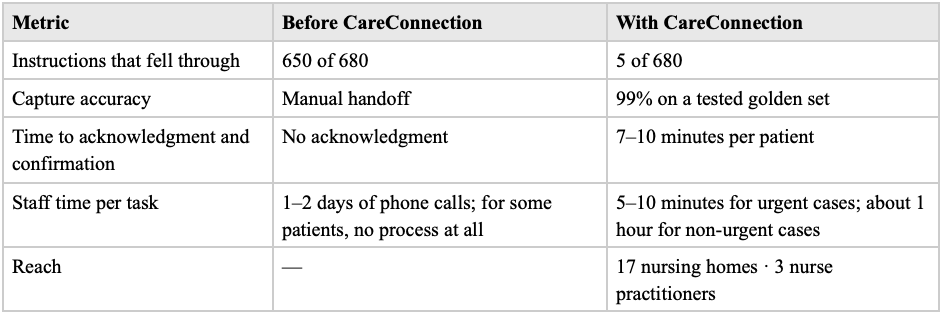
Before CareConnection, only about 4% of follow-up instructions were completed and confirmed. With CareConnection, that figure rose above 99%. Staff time spent chasing confirmations dropped from days to minutes for urgent cases and to about an hour for non-urgent ones.
"The headline number is the drop from 650 missed instructions to 5, but the more transferable lesson is the method: measure against a confirmed baseline before you build, so the improvement can be defended."
Why it matters
Somara's contribution goes beyond building a tool. She turned a fragile, invisible part of care delivery — the moment between a clinical decision and a completed action — into a measurable, accountable process. Her approach combined careful observation of real care episodes, a clear operating model, practical AI design and rigorous measurement against a confirmed baseline. For the nursing homes in the pilot, the change was concrete. Instructions stopped falling through the cracks, facilities knew exactly who owned each task, and physicians finally had confirmation that their patients received the care they ordered.
Her work points to how AI can strengthen healthcare: not by replacing clinical judgment, but by making sure clinical judgment reliably reaches the patient.